Thursday, April 28, 2022

What is Early Release Probation?

Many people find themselves convicted of petty crimes in the state of Texas. It is extremely common that these same people are required to serve probationary periods as a part of their sentence. What is often forgotten, however, is that a certain set of circumstances can get someone off of their probation and back into everyday civilian life. As this is seldom achieved without a lawyer, it is heavily recommended that you reach out to a Houston criminal defense attorney as soon as you are able. The Law Office of David A. Breston has lawyers ready at the click of a button so that you are able to regain the livelihood and well-being that you once had.

What Is Early Termination of Community Supervision?

Early release probation, also commonly referred to as early termination of probation, is an instance in which someone’s probationary period is cut short due to a set series of circumstances that are presented and accepted by a court. Contrary to popular belief, this can be achieved for misdemeanors and felonies alike. In any case, it is imperative to remember that judges are not required to grant early release probation to anyone – even if they meet the guidelines most often met by individuals who do receive early termination of probation.

There are numerous factors that a judge will consider when deciding to end your probation or community supervision:

  • The nature of the crime committed that led to the sentencing of probation, particularly if it was among excluded crimes
  • The amount of probation time that has already been completed
  • One’s general behavior while on probation

As previously mentioned, the decision to grant an early release of probation is at the complete discretion of the judge. To increase the chances of being granted this release, probationary violations should be minimized to the very minimum.

The Issue of Discretion: How Attorneys Help in Texas

In the case of securing early release probation, a criminal defense attorney is more important than ever. A judge, first and foremost, must be convinced that you are worthy of an early release. This is rarely an easy task and should be left up to lawyers who are well-accustomed to convincing judges of granting this sort of benefit to their clients. Criminal defense and probation attorneys have on-floor experience with judges who may desire certain circumstances in order to grant an early termination of a probationary period. 

Where Do I Turn for Help in Houston? 

There are some law firms that are more dedicated to the success of their clients than others. While some firms seek fast and easy payouts, others are eager to do everything they can to improve the livelihoods of their clients. The Law Office of David A. Breston is one of those looking to help those in need. Our firm even offers free confidential consultations at the click of a button. We can be reached by calling 713-804-6492 where a Houston criminal defense attorney will be able to address all of your questions and concerns. Contact us today to learn more about how your loved one could be granted early release probation.

The post What is Early Release Probation? appeared first on Law Office of David A. Breston.


from Texas Bar Today https://ift.tt/fI3sgRX
via Abogado Aly Website

Industrial ADA litigation – “roll me baby, just like a tumbling dice.”

The Rolling Stones famously asked that they be rolled like a pair of tumbling dice, and looking at recent Title III ADA headlines reminded me of just what a crapshoot ADA litigation can be. The good news for businesses is that the district attorneys of San Francisco and Los Angeles have filed suit against the Potter Handy firm and its partners alleging that the firm filed false lawsuits under the ADA.¹ Hard on the heels of the action by the local authorities a federal judge in San Francisco, Vince Chhabria, entered a series of show cause orders requiring the Potter Handy firm and its clients to file sworn declarations providing factual support for their allegations concerning having visited and intending to visit ADA defendants in the future.² I don’t know how Potter Handy and its clients will respond to these orders, or what Judge Chhabria will do with those responses, but within days of these actions a federal judge in San Jose entered an all too typical order allowing a case to proceed despite being more or less identical to those being handled by Judge Chhabria. Sevens or snake eyes, in ADA Title III matters defendants and plaintiffs are at the mercy of the random assignment of judges done with each federal lawsuit filed.

First, a little background to Judge Chhabria’s orders. Because Title III of the ADA only provides for injunctive relief a plaintiff cannot maintain a lawsuit under Title III unless they allege and ultimately prove they plan to go back to the same store or restaurant they are suing. This is because in a private lawsuit federal courts cannot make orders that are only for the public good. Whatever the court does must be of benefit to the plaintiff. If the plaintiff is never going back to the property then ordering the owner to comply with the ADA won’t do the plaintiff any good. Thus, for the federal court to act the plaintiff must show they will return in the future; otherwise the court will dismiss the case for lack of jurisdiction.

It has been obvious for years that a serial lawsuit filer claiming they will return may not be telling the truth. After all, how likely is it that someone who has sued dozens of restaurants that they never ate at before really intends to go back to all of them?  However, in the earliest part of a lawsuit, before there has been any evidence, the court has to assume that what the plaintiff says in their complaint is true as long as it is minimally plausible. That means it is hard to get these cases dismissed early on, which in turn means that it they are expensive to fight. Since the owner doesn’t get back their attorneys fees  even if they win it always makes business sense to just settle and save money. That logic has lead to tens of thousands of settlements and made it highly profitable for law firms to file Title III ADA suits. For very little effort they can make thousands or tens of thousands of dollars on each case they file. This is the origin of industrial litigation under Title III; there is an incentive to file lawsuits on an industrial scale based on the structure of the ADA and the nature of the Federal Rules of Civil Procedure.

This incentive is especially strong in California because a plaintiff can always add a claim under the state’s Unruh Act. Under the Unruh Act the plaintiff gets a minimum of $4,000 in damages, meaning that the risk of litigation is higher and the plaintiffs’ lawyers can demand and get higher settlement amounts. The Unruh Act is why some 40% of all ADA cases nationwide are filed in California state or federal court.

The California legislature tried to put a stop to this use of the Unruh Act by making filing claims under the Unruh more expensive and difficult in state court. Unfortunately, state laws don’t affect how the federal courts do business, so many plaintiffs have kept filing in federal court while tacking on an Unruh Act claim, thus getting the benefit of the $4,000 damage amount without the hassle of the state court requirements. Seeing that they were being used by these plaintiffs many federal courts in California began refusing to consider Unruh Act claims – something technically called refusing to exercise supplemental jurisdiction.³ I say many federal courts because this isn’t universal. The rules about supplemental jurisdiction leave a lot of discretion to the federal judge, and some just think it is o.k. to allow Unruh Act claims to tag along with an ADA claim.

That brings us to two lawsuits that are kind of hard to tell apart. One, Whitaker v. Peet’s Coffee, Inc. is pending before Judge Chhabria in the San Francisco Division of the United States District Court for the Northern District of California as Case No. 21-cv-07698. The other, also called Whitaker v. Peet’s Coffee, Inc. is  pending before Judge Beth Labson Freeman in the United States District Court for the Northern District of California, San Jose Division as Case No. 21-cv-05163. Both were filed by the Potter Handy firm. I have not read the complaints, but it would be surprising if there was any significant difference except the address of the Peet’s Coffee that Mr. Whitaker supposedly visited. It is safe to say that given the number of lawsuits filed in Mr. Whitaker’s name these complaints are more like Fords rolling off the assembly line than Maseratis being hand crafted in Italy.

Despite their obvious similarities, within the last few days the two federal judges involved reached completely different conclusions about how to handle these cases. On April 19 and 20, 2022 Judge Chhabria entered  orders requiring an evidentiary hearing on whether Mr. Whitaker has standing to sue and ordering Mr. Whitaker and his attorneys to show cause why his Unruh Act claims should not be dismissed. This case is a little further along than the cases in which Judge Chhabria entered his show cause orders, but his approach is clear. He is skeptical of the plaintiff’s claim that he has ever been to the defendant Peet’s Coffee store and equally skeptical that he ever plans to return. Instead of waiting for a trial to hear the evidence on these issues he is going to take evidence early and, if it turns out the plaintiff cannot prove an intent to return, dismiss the case before he and the lawyers spend too much time on it.(4) He has also fairly clearly aligned himself with those federal judges who are declining to exercise supplemental jurisdiction over Unruh Act claims, thus making it a little less profitable to file ADA cases if they end up in his court.

Judge Freemen has taken a very different approach. In a decision entered on April 21, 2022 she refused a request that she do what Judge Chhabria is doing. I will let her speak for herself on this:

Overall, however, the Court agrees with Judge Orrick and several other courts in this Circuit that “if an ADA plaintiff is going to be disbelieved on the issue of standing, it should be in the context of factfinding, not in the context of a Rule 12(b)(1) motion.” Garcia, 2021 WL 7285264, at *4 (brackets omitted).
Here, given Plaintiff’s unequivocally asserted intent to return to the Coffeeshop and the absence of direct evidence rebutting that intent, the Court does not find that an evidentiary hearing is warranted. That said, the Court notes that discovery has yet to commence, and it is under a continuing obligation to ensure subject matter jurisdiction exists over Plaintiff’s claims at all times. Should subsequent facts arise in the course of discovery that would provide a direct basis to doubt Plaintiff’s sworn statements of his intentions to return to the Peet’s Coffee, Defendant is welcome to renew its standing challenge at that point.
Whitaker v. Peet’s Coffee, Inc., 2022 WL 1189888, at *5 (N.D. Cal. Apr. 21, 2022). She then concludes by refusing to dismiss the Unruh Act claim, leaving the plaintiff with a larger threat and making the case more valuable to the plaintiff’s lawyers. She does suggest she might consider a challenge to standing at some point before trial, but by then it will be too late because as a practical matter the defense costs will have far exceeded the cost of settlement.

I’m sure Judge Freeman does not think of herself as a proponent of industrial ADA litigation, but her unwillingness and that of many other federal judges to address standing to sue and the credibility of allegations of intent to return at the very beginning of the case has the effect of perpetuating a system that causes millions of dollars to be spent on lawyers and does almost no good for those with disabilities. In many cases the effect of an ADA lawsuit is simply to drive a small business out of business, thus making sure no disabled person will ever benefit from its goods and services. In most cases, I believe, the plaintiff’s lawyers get their money and walk away so that the owner never has to make the property accessible(5). The fees paid to settle these cases are just a tax businesses pay to avoid complying with the ADA.(6)

Whether you agree with Judge Freeman or Judge CChabria about how to approach ADA cases, it is disturbing that the fate of defendants and plaintiffs alike depends on the random assignment of cases to federal judges. No matter which side you are on, the determining factor in the outcome of the lawsuit will be the initials put after the case number that indicate which judge the case was assigned to. If you are a plaintiff or plaintiff’s lawyer and you see BLF after the case number you’ve hit the jackpot and it is almost certain you’ll get a quick and easy payday by settlement. If you are defendant and you see VC after the case number there’s a good chance you can either make a better deal or even get out of the case entirely at a reasonable cost of defense. I haven’t surveyed all 19 judges in the Northern District of California, but I’m sure that others can be found on both sides of this divide, or even taking their own independent approach to these issues.

The lawsuit against Potter Handy by the San Francisco and Los Angeles district attorneys might have some effect on these cases, but the outcome is probably years away and won’t affect the many other firms who file serial ADA lawsuits. The solution lies, unfortunately, with Congress, which has been notoriously dysfunctional for some years. For now defendants in Title III ADA lawsuits can only hope for the best and make sure their defense or settlement strategy is based on what can be known about the individual judge to whom their case is assigned. It is that assignment, not any principle of law, that will likely determine the outcome. We are all like Mick Jagger, except that it is a computer down at the District Clerk’s office that’s going to “roll me, just like a tumbling dice.”

+++++++++++++++++++++++++++++

¹ Thanks to Jim Vitale and William Goren for calling my attention to the filing. One of several stories about the filing can be found at https://www.courthousenews.com/law-firm-accused-of-ada-shakedown-of-small-businesses/ I cannot say, of course, whether the claims have any merit.

² See, Federal Judge in San Francisco Challenges Lawsuits Filed by Aggressive ADA Law Firm

³ See my blog Supplemental Jurisdiction for my earliest note about this kind of dismissal. Search “supplemental” in accessdefense.com and you’ll find the many updates I’ve posted on where various courts stand on the issue.

(4) It is a depressing truth that by the time a case gets as far as this one the defense costs have already exceeded the cost of settlement, but Judge Chhabria’s orders in newly filed cases have the potential to save defense costs by getting rid of meritless cases early on.

(5) Assuming, of course, that there was ever a real accessibility problem.

(6) I’ll note here, as I have many times before, that this kind of industrial litigation has been going on for at least 15 years and the number of cases continues to increase. If this kind of lawsuit were working as a way to persuade businesses to become accessible we would see the number of filings going down, not up. Industrial litigation is a failure in terms of ADA compliance; only the lawyers benefit.


from Texas Bar Today https://ift.tt/rOKPmI2
via Abogado Aly Website

Wednesday, April 27, 2022

Can an Inaccurate Police Report About a Crash Be Corrected?

If there is a mistake on a police report after an accident, you may be able to have it corrected while you file a claim for compensation.


from Texas Bar Today https://ift.tt/LmWj7ZY
via Abogado Aly Website

Southwestern Stay

The Dallas Morning News reported that the Fifth Court stayed the Rule 202 depositions of two UT-Southwestern executives in connection with its program for transgender use; the mandamus proceeding continues to be briefed in the meantime.

The post Southwestern Stay appeared first on 600 Commerce.


from Texas Bar Today https://ift.tt/pqRBxSZ
via Abogado Aly Website

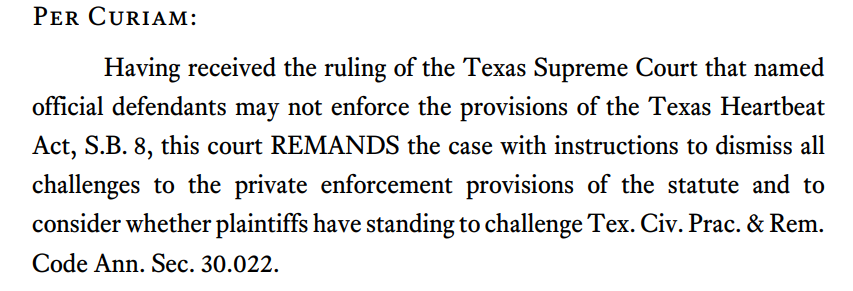
SB8 Case Leaves CTA5

The saying “that’s all she wrote” was particularly apt for the Fifth Circuit yesterday, as the hard-fought litigation brought by abortion providers to challenge Texas’s SB8 took its final turn back to the district court:

Whole Woman’s Health v. Jackson, No. 21-50792 (April 26, 2022).


The post SB8 Case Leaves CTA5 appeared first on 600 Camp.


from Texas Bar Today https://ift.tt/OB6MatS
via Abogado Aly Website

I Graduate Today

If you are here to find the one takeway that will make a difference in your life and career, here goes:

It is not how you treat your clients when you are feeling well that will matter, it is how you treat your clients when you are not feeling well. One other quick takeaway. It is not how you treat your clients when they are feeling well that they will remember. But, they will most definitely remember how you treated them when you knew they weren’t well.

First.I should say I am writing to celebrate our wonderful home at Diamante Cabo San Lucas. Nancy went down on April 11, her birthday to open our house. I hope I will be able to go May 24. We’ll see how I am doing.

Front of House
Back of House with Pool


When I started writing blog posts for lawyers I never dreamed the title of one would be I graduate today. My graduation will take place at around 9:50 this morning. I don’t think the doctor or nurses will call in graduation, but I will have lived through six chemo treatments and thirty radiation treatments.

If you are like I was a couple of months ago, you might think that means I can shake the hands of the doctors and kiss the nurses and say goodbye. I discovered, as many of you who have gone through this discovered, that when you are a cancer patient your specialist doctors and nurses will be taking care of you for the rest of your life. The radialogist will start scans with a CT scan in a month and I will visit Lauren, my surgeon’s nurse once a month for the next year (just to check on my neck). Lauren makes all the difference in the world to me and my care.

My friends have asked me how I feel now that radiation and chemo are finished, at least for the foreseeable future. I would like to tell them I feel excited I have finished. There is only one slight problem-I am too exchausted to be excited about anything and if I acted excited I would eventually have to swallow and that will both hurt my throat like you know what, and I won’t be able to taste what I am eating. I confess I didn’t know that a person can sleep all day and get up go to bed and be out like a light all night. I know that I used to exercise but I have’t done that in some time. I would read, but I can only concentrate for one to two minutes at tha most.

I know I should be happy to have gotten through this phase of my care, but I have no energy to show it. I tried to take a photo of my burned neck and ear, but I decided to simply say it is burned skin which has created open sores.  No matter what I do I leave blood stains all over my pillow case and sheet each night. Going to the Internet, I am among the thousands who have had these side effects.

While writing this blog post, I received a graduation gift from a group of lawyers I coached who have been supporting me. Our doorbell rang and when I went to the door there was a box. I opened the box and took out paper literally all the way to the bottom. When I got there I found a book the group had created of my blog posts each valued. Each lawyer who contributed received a copy for their bookcase/desk. I am told the printer can print more copies. Toronto lawyer and my friend Phil Moore wrote a forward.  He had sat through the first time I met with McCarthy Tetrault lawyers in Toronto. He wrote about my discussion of Seth Godin’s book Purple Cow.. Seth Godin deserves all the credit for creating the Purple Cow marketing concept. In my coaching I deserve credit for sharing Seth Godin’s writing and blog posts with lawyers I coached.

Today I enter post radiation and chemo care. I have been told the next four weeks will be somewhat like the last couple of weeks when it has been hard to swallow. May I end by saying I am looking forward to the first time I can say I am looking forward to the steak dinner I booked at my favorite Dallas or Fort With restaurant. Since it will be a really big deal for at least me, I create a big fanfare and like a star high school player announcing where he will go to school. I will have hats for the four finalist steak restaurants on a table and at the appointed time I will put on the hat of where I plan to eat a steak dinner and maybe even enjoy a martini. If I go to all that trouble and make it a big deal, you’ll know my taste buds are back.


from Texas Bar Today https://ift.tt/AjWC3x1
via Abogado Aly Website

You Received an IRS CP518 Notice. Now what?

Overview of IRS Notice CP518.

The IRS Collection Procedure Notice 518 (CP518) is a notification that the IRS believes a taxpayer—either a business or an individual—has failed to file a required return, either as of the initial deadline for filing or as of any extension deadline. Pursuant to 26 U.S.C. § 6212 and Treasury Regulation § 301.6212-1, the IRS uses CP518 as one of various progressive notifications to taxpayers for tax assessment or collection process. See IRS Guidance for CP 518 Business and IRS Guidance for CP 518 Individual.

Last Known Mailing Address.

Pursuant to Section 6212, if the IRS determines that there is a deficiency in respect of any federal income tax, including any excise tax authorized by Chapter 42 of the Internal Revenue Code, the IRS is authorized to send a notice of deficiency to the taxpayer by certified mail or registered mail. The CP518 notice must include a notice to the taxpayer of the taxpayer’s right to contact a local office of the taxpayer advocate and the location and phone number of the appropriate office.

Documentary evidence of the IRS mailing a CP518 notice to the taxpayer’s last known address is sufficient that a notice of deficiency was properly mailed. See 26 U.S.C. § 6212(b); Treasury Regulation § 301.6212-1(b). If a taxpayer has a legitimate basis to claim that a CP518 notice was not properly delivered, the taxpayer may challenge a CP518 notice on that basis. However, a taxpayer’s unsupported statement of “I don’t recall receiving the notice” is usually an argument that is rejected by the U.S. Tax Court. See Golditch v. Comm’r, T.C. Memo. 2022-26 (March 29, 2022); see also Freeman Law Insights Blog on Golditch.

Pause, But Take Action To Give to (or File With) Ceasar What Is His, If And As Required by the Internal Revenue Code.

Any return that was required to be filed but was not should be prepared and filed with the IRS, even if delinquent. The IRS Guidance for a CP518 conveys a sense of urgency or immediacy to file whatever return was required to be filed but was not. But, haste often causes “nasty things.”

A taxpayer is wise to pause, closely evaluate what tax returns were required and were or were not filed, and prepare accurate returns as required to comply with tax filing obligations. The individual taxpayer who receives a CP518 must also complete and submit IRS Form 15103 (Form 1040 Delinquency), explaining why the taxpayer filed late, does not have to file, or already filed all required returns. A portion or stub connected with the CP 518 must be submitted with the Form 15103. Business entity taxpayers will likewise be asked–usually through the CP518–to complete and submit a similar explanatory response form that accompanies the CP518.

The “pause” on filing a delinquent return should be reasonable so that the IRS does not itself prepare and file a substitute for return, which the IRS is authorized to do (and under no particular timeline). A dilatory or acquiescent attitude is not recommended.

Substitute for Return.

Where a taxpayer fails to file a required return, the IRS may prepare, for tax assessment purposes, a substitute for return showing, for example, taxes owed, generally, and additional taxes under section 6651. See 26 U.S.C. § 6020(a) (“If any person shall fail to make a return required . . . the [IRS] may prepare such return . . . ”); id. at § 6651(g)(2) (authorizing additions to tax in substitute for return). In addition, if no return is filed and the IRS prepares a substitute return, then the taxpayer has made no election for deductions and may not later claim itemized deductions. See Salter v. Comm’r, T.C. Memo. 2022-9 (April 5, 2022); George v. Comm’r, T.C. Memo. 2019-128, 118 T.C.M. (CCH) 294, 296, aff’d per curiam, 821 F. App’x 76 (3d Cir. 2020); see Zaklama v. Comm’r, T.C. Memo. 2012-346, 104 T.C.M. (CCH) 760, 777.

Unless a taxpayer can prove that the failure to file a return is due to reasonable cause and due to willful neglect, an additional tax may be assessed, and the IRS’s burden of proof to sustain the assessment determined in a substitute for return is not onerous. See 26 U.S.C. § 6664.  To establish reasonable cause, the taxpayer must show that it exercised ordinary business care and prudence’ but nonetheless was unable to meet its obligations.  U.S. v. Boyle, 469 U.S. 241, 245-46 (1985).

Insights.

It is very important that a taxpayer receiving a CP518 notice act quickly but prudently to address the situation before it gets worse. If a taxpayer refuses or fails to prepare and file a required return, the IRS may itself prepare and file a substitute for return, and in that event, the taxpayer will be disadvantaged from claiming, for example, available itemized deductions and other lawful offsets to tax liability as allowed by the Internal Revenue Code. Indeed, the law–even the Internal Revenue Code, at times–helps those who help themselves, the vigilant, rarely the sleeping, and never the acquiescent. If a taxpayer receives a CP518, acquiescence is ill-advised. Upon receipt of CP518, evaluate, connect with competent professionals, if and as needed, and take charge of the potential tax filing and liability that the IRS believes is outstanding.

The post You Received an IRS CP518 Notice. Now what? appeared first on Freeman Law.


from Texas Bar Today https://ift.tt/0niWGF2
via Abogado Aly Website